Contents
The question arrives as a request for one number, and an honest answer is a table. Published research puts the onset of roof damage at 1 inch for aged three-tab shingles, 1.25 inches for laminated shingles and cedar, 1.5 to 1.75 inches for shakes, tile and slate, and at least 2.5 inches to rupture metal. Each figure holds only under stated conditions.
Why one inch became the line
The one-inch figure has a history that connects weather warnings to roofs. When the National Weather Service reviewed its severe thunderstorm criteria, the hail threshold stood at three quarters of an inch. Engineers from Haag presented their impact tests to that review and concluded that, from a roof damage perspective, the threshold could be raised to one inch and would still be conservative1. Today NOAA classes hail of quarter size or larger as severe2, and the Storm Prediction Center's daily summaries have recorded hail of 1 inch and greater since January 5, 20103.
The practical consequence is that hail below one inch generally does not appear in those daily summaries, and one inch is where damage to roofing begins, not where it becomes likely.
The laboratory results
Haag built test panels of nine roofing products, some naturally weathered for years, and launched solid ice stones at them at free-fall speed. Each product took ten impacts at each size, perpendicular to the surface, at room temperature1. The table gives the share of impacts that caused damage.
| Roofing product (age at test) | 1 in | 1.25 in | 1.5 in | 1.75 in | 2 in |
|---|---|---|---|---|---|
| Three-tab shingles, organic mat (11 years) | 50% | 90% | 100% | 100% | 100% |
| Three-tab shingles, glass-fiber mat (11 years) | 0% | 60% | 90% | 100% | 100% |
| Laminated shingles, 30-year (11 years) | 0% | 0% | 60% | 90% | 100% |
| Cedar shingles (11 years) | 0% | 30% | 80% | 100% | 100% |
| Heavy cedar shakes (new) | 0% | 0% | 50% | 90% | 100% |
| Fiber-cement tiles (new) | 0% | 20% | 80% | 100% | 100% |
| Flat concrete tiles (new) | 0% | 20% | 50% | 50% | 100% |
| S-shaped concrete tiles (new) | 0% | 0% | 0% | 0% | 80% |
| Built-up gravel roofing (8 years) | 0% | 0% | 0% | 0% | 30% |
Source for every cell: Haag Engineering, Table 21. The organic-mat three-tab shingles were also struck at 3/4 inch and took no damage1. One product of nine was damaged at 1 inch, five at 1.25 inches and all nine at 2 inches1.
The field thresholds
Laboratory figures are checked against what inspectors find after real storms. Haag's engineers surveyed hundreds of roofs in more than a dozen hailstorms, in cities including Dallas, Denver and Minneapolis, and report good correlation with the laboratory series1.
| Roofing material | Threshold hail size | Source |
|---|---|---|
| Three-tab asphalt shingles | 1 inch | Haag field observations1 |
| Laminated asphalt shingles | 1.25 inches | Haag field observations1 |
| Cedar shingles | 1.25 inches | Haag field observations1 |
| Medium cedar shakes | 1.5 inches | Haag field observations1 |
| Fiber-cement tiles | 1.5 inches | Haag field observations1 |
| Clay tiles | 1.5 inches | Threshold table reproduced by IIBEC4 |
| Gray slate, 1/4 inch thick | 1.5 inches | Threshold table reproduced by IIBEC4 |
| Green slate, 1/4 inch thick | 1.75 inches | Threshold table reproduced by IIBEC4 |
| Concrete tiles | 1.75 inches | Haag field observations1 |
| Metal panels (rupture) | At least 2.5 inches | Haag 2010 testing, as reported by its chief executive5 |
| Built-up gravel roofing | 2.5 inches | Haag field observations1 |
Haag restated the two shingle figures in 2019: 1 inch or greater for three-tab shingles and 1.25 inches or greater for laminated shingles6.
Why a little more diameter is a lot more damage
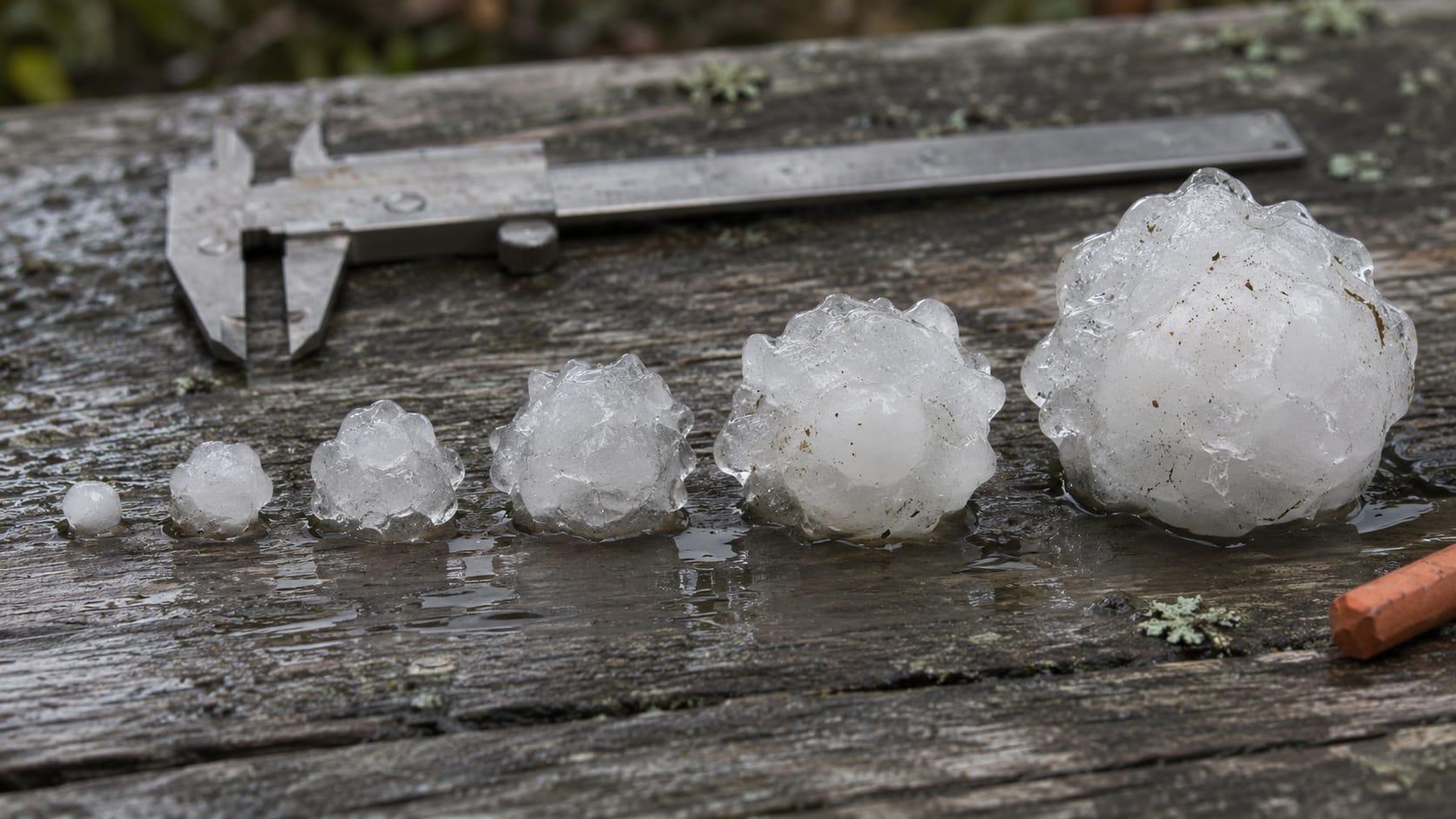
Impact energy climbs much faster than size. The figures Haag used for its launch speeds show the scale.
| Hail diameter | Everyday object (NSSL)2 | Terminal velocity of a solid ice sphere1 | Impact energy1 |
|---|---|---|---|
| 1 inch | Quarter | 50 mph | Under 1 ft-lb |
| 1.25 inches | 56 mph | 4 ft-lb | |
| 1.5 inches | Ping-pong ball | 61 mph | 8 ft-lb |
| 1.75 inches | Golf ball | 66 mph | 14 ft-lb |
| 2 inches | 72 mph | 22 ft-lb | |
| 2.5 inches | Tennis ball | 80 mph | 53 ft-lb |
| 3 inches | Tea cup | 88 mph | 120 ft-lb |
Two points follow. A 2-inch stone carries more than twenty times the energy of a 1-inch stone, so a small error in the size estimate changes the conclusion. And these are speeds for solid ice spheres. Natural hailstones are layered and less dense, and the National Severe Storms Laboratory reports that they fall more slowly: 25 to 40 mph for stones of 1 to 1.75 inches and 44 to 72 mph for stones of 2 to 4 inches2. Haag's authors say as much: freezer ice is harder and denser than natural hail, and perpendicular strikes deliver the maximum energy, so the laboratory series is a worst case1.
What moves a threshold up or down
The authors of the threshold study list the variables themselves: the stone's size, shape, hardness, speed and angle of impact, and the roofing's type, age, support, impact location and temperature1. Three of these decide most disputes.
Age and wear. The thresholds assume a roof in relatively good or midlife condition7. IBHS found that shingles exposed to natural weathering and two simulated events of hail under 1 inch became up to ten times more susceptible to damage from later large hail than new shingles8. Small hail does this by knocking away the granules that protect the asphalt from sunlight8.
Support. Shingles with little or nothing beneath them, along ridges, rakes, eaves and valleys, are particularly susceptible9. Built-up roofing over a hard deck showed substantial hail resistance1.
Hardness and angle. The thresholds assume hard hail and a perpendicular strike7. Softer stones deliver less, and so do the glancing impacts that reach a leeward slope9.
Impact-rated shingles
Two laboratory standards rate impact resistance. UL 2218 drops steel balls of various diameters from 12 to 20 feet onto a deck of shingles and sorts products into four classes, with Class 4 the best. FM 4473 launches ice balls instead and uses the same four classes10. Shingles made with polymer-based modifiers were developed to meet Class 41, and a rating may earn a discount on home insurance in some areas and from some insurers10.
A rating is not a threshold. The trade association that describes these standards adds that laboratory tests do not fully replicate real-world conditions and apply to shingles as manufactured10. IBHS runs its own protocol with 1.5-inch and 2-inch laboratory hailstones on shingles bought through consumer channels, and has reported on 22 products from five manufacturers11. It also notes that current standards do not assess how performance holds up over time8.
How to use the thresholds in a claim file
- Establish the hail size at the property. The dents in air-conditioner fins are the best gauge, typically 80% of the stone's diameter, and spatter marks grow with the hail7.
- Check it against the radar estimate. NOAA's MRMS system produces a Maximum Estimated Hail Size product that can help verify hail after the fact12. It is an estimate for a grid cell. Skybridge Intelligence's sample report, which lists the maximum MESH over the analysed area and within 5 and 10 kilometres, carries the warning that the hail at a given spot may have been smaller or larger13.
- Compare with the threshold for the roofing. Then adjust for age and support. A fifteen-year-old three-tab roof and a new laminated one do not share a number.
- If the size is below the threshold, look at the weakest roofing. When hail was large enough to damage well-supported shingles, some of the poorly supported ones on ridges and valleys should be damaged too6. If they are not, the marks in the field of the roof need another explanation.
- Keep the size evidence with the date evidence. A threshold argument is only as good as the proof that hail of that size fell on that day, which is the subject of the guide to proving when hail fell.
The file is complete on this point when it holds three numbers that agree: the size the property's metal indicates, the size radar estimated for that cell, and the threshold for the roofing in its actual condition.
Can 1 inch hail damage a roof?
It can damage the most vulnerable roofing. In Haag Engineering's tests, 11-year-old three-tab shingles with organic mats were damaged by half of 1-inch ice-ball impacts. Glass-fiber three-tabs, laminated shingles, wood, tile and built-up roofing took no damage at 1 inch in the same tests.
Can pea size or dime size hail damage a roof?
Not by fracture. Pea-size hail is about a quarter inch across, and Haag's tests found no damage even to aged three-tab shingles at three quarters of an inch. IBHS has found, however, that repeated small hail knocks away granules and leaves shingles more vulnerable to later large hail.
Will golf ball size hail damage a roof?
Golf-ball hail is 1.75 inches, at or above the published threshold for every common steep-slope material. In Haag's laboratory series it damaged aged three-tab and cedar shingles in every impact and aged laminated shingles in 90% of impacts. S-shaped concrete tiles took no damage at that size.
What size hail is considered severe?
One inch, the size of a quarter. NOAA's National Severe Storms Laboratory classes hail of quarter size or larger as severe, and the Storm Prediction Center's daily storm report summaries have recorded hail of 1 inch and greater since January 5, 2010.
Are Class 4 shingles hail proof?
No. Class 4 is the highest of four classes in UL 2218, a laboratory test that drops steel balls onto shingles from 12 to 20 feet. The asphalt roofing industry's trade association notes that such tests do not fully replicate real-world conditions, and IBHS runs a separate test with manufactured hailstones.
Sources
- Hail Damage Threshold Sizes for Common Roofing Materials (Marshall, Herzog, Morrison and Smith; 21st Conference on Severe Local Storms). Haag Engineering Co., via the American Meteorological Society, 12 Aug 2002. Accessed 20 Nov 2026.
- Severe Weather 101: Hail Basics. NOAA National Severe Storms Laboratory. Accessed 20 Nov 2026.
- Severe Weather Event Summaries: storm reports. NOAA/NWS Storm Prediction Center. Accessed 20 Nov 2026.
- Asphalt Composition Shingle Damage: Hail or Manufacturing Defect? (Darrell L. Smith, RRC, PE; Interface, February 2013). IIBEC. Accessed 20 Nov 2026.
- Testing Your Mettle: court rulings on cosmetic hail damage to metal roofs (Justin Kestner, Haag Engineering Co., and Kevin J. Kennedy). CLM Magazine, 21 Jul 2016. Accessed 20 Nov 2026.
- Assessing Hail Damage: Part 2, Hail Inspection Protocol (Kestner, Smith and Chaney; October 2019). Haag. Accessed 20 Nov 2026.
- Holy hail! (Scott J. Morrison, P.E., Haag Engineering Co.). Professional Roofing, National Roofing Contractors Association, 1 May 2009. Accessed 20 Nov 2026.
- Impact Testing of High Concentrations of Small Hail. Insurance Institute for Business & Home Safety (IBHS). Accessed 20 Nov 2026.
- Hail Damage to Asphalt Roof Shingles (Marshall, Herzog and Morrison; American Meteorological Society Annual Meeting, 2004). Haag Engineering Co.. Accessed 20 Nov 2026.
- Asphalt Shingle Product and Test Standards. Asphalt Roofing Manufacturers Association (ARMA), 18 Nov 2025. Accessed 20 Nov 2026.
- Relative Hail Impact Resistance of Asphalt Shingles. Insurance Institute for Business & Home Safety (IBHS). Accessed 20 Nov 2026.
- Severe Weather 101: Hail Detection. NOAA National Severe Storms Laboratory. Accessed 20 Nov 2026.
- A complete sample report (Kankakee, IL, 10 March 2026). Skybridge Intelligence. Accessed 20 Nov 2026.
Updated 20 Nov 2026: First published.