
Contents
People searching for what hail damage looks like usually have one roof in mind and photographs from a different one. The pictures online are mostly of asphalt shingles. A cedar, tile, slate or metal roof records the same storm in a different way, and the mark that counts as damage is different on each.
One definition, five materials
The published definition of hail damage does not change with the material. A roof is functionally damaged when hail reduces its ability to shed water or shortens its expected service life1. What changes is how each material fails. Flexible roofing bruises and tears. Wood splits. Rigid roofing fractures. Metal dents long before it opens.
It also helps to know where to look first. Hail falls at random and is steered by the wind2, so the slope that faced the storm takes the most concentrated and direct impacts and the leeward slopes take fewer, glancing ones3. Roofing with little support beneath it, along ridges, rakes, eaves and valleys, is damaged first3. IBHS singles out ridge caps as especially vulnerable on an asphalt shingle roof4.
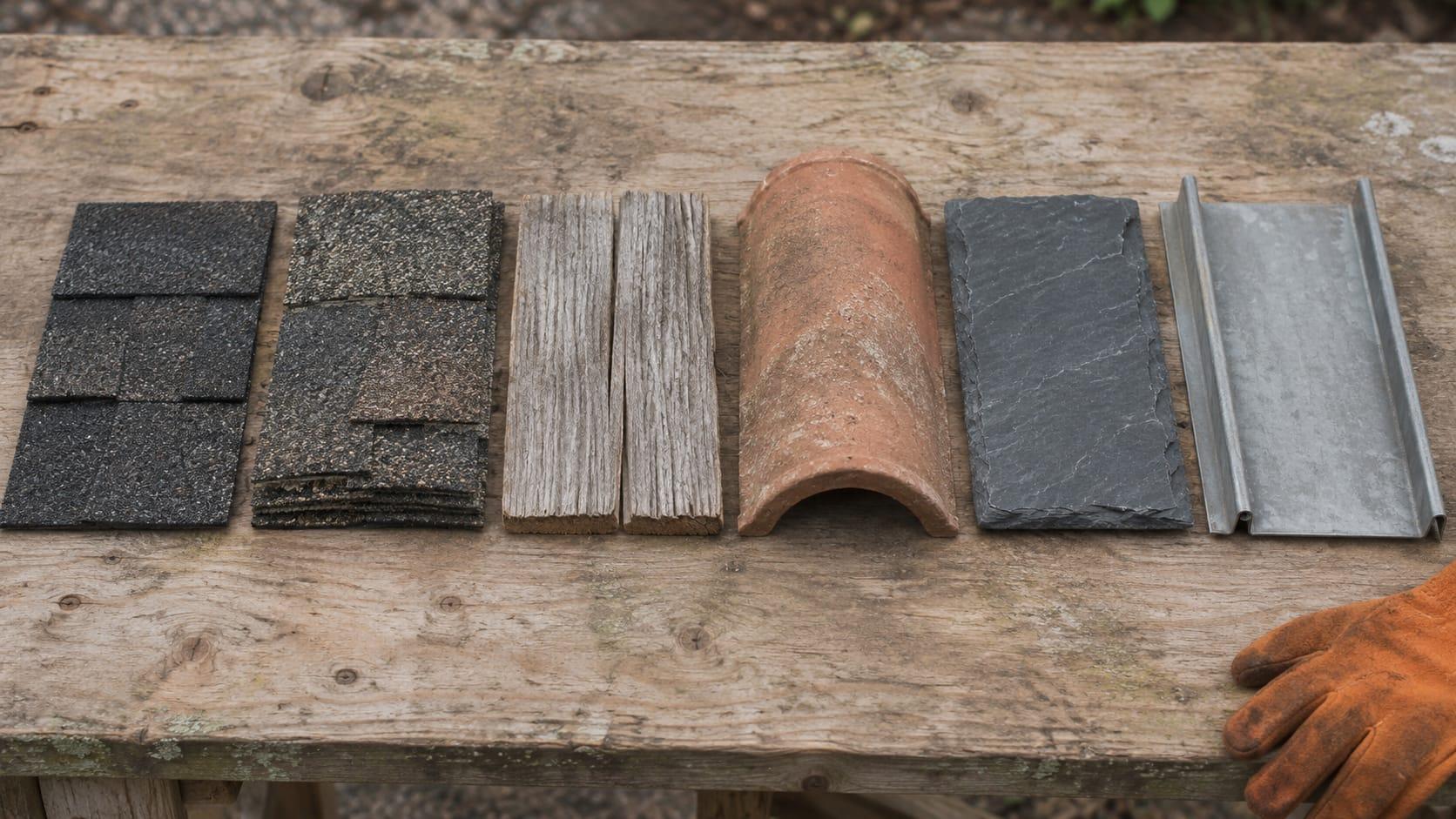
The mark that counts, material by material
| Roof type | What a hail impact looks like | When it is functional damage |
|---|---|---|
| Asphalt shingles, three-tab and laminated | Displaced granules over a soft bruise; hits that look black and feel like the bruise on an apple35 | A bruise (fracture of the mat), a puncture, or granules displaced enough to expose the bitumen6 |
| Wood shingles and shakes | A split along the grain beside a sizeable dent; bright orange inside when recent1 | A puncture or split that reduces the shake's ability to shed water1 |
| Clay and concrete tile | Multiple fractures radiating from one impact point; corners lopped away along curved lines1 | A fracture that exposes underlayment or fasteners1 |
| Slate | Fractures from single arcs to several radiating from one point; soft, weathered slate may be crushed1 | A fracture that exposes underlayment or fasteners1 |
| Metal panels | Dents, dimples and dings7 | A ruptured panel, a disengaged fastener, an opening along a seam or a protective coating removed7 |
Asphalt shingles
Three-tab and laminated shingles show hail the same way. The stone knocks granules loose and, if it is large and hard enough, fractures the mat beneath them. Haag's engineers describe the result as an indentation with a fracture in the mat that feels soft, like the bruise on an apple, usually made obvious by the granules dislodged around it3. The fracture starts on the underside of the shingle, where the strain is greatest, and travels toward the surface, which is why it can always be detected from below1. Atlas Roofing's bulletin gives the practical version: lift several shingles at random and look for ruptures on the back8.
Colour dates the mark. Recently exposed asphalt is black. After several months it oxidises to grey3. Grey impact marks are therefore older than a storm of the week before.
Laminated shingles are thicker and take larger hail to bruise: Haag's published thresholds are 1 inch for three-tab shingles and 1.25 inches for laminated ones6. Shingles sold as impact-resistant are classified by UL 2218, a laboratory test that drops steel balls onto a shingle deck and sorts products into four classes9. IBHS's water tests point to tears as the mark that matters most for leaks: small dents let through negligible water, while a tear rated near 1 on its 0 to 3 severity scale let through large amounts10.
Wood shingles and shakes
Cedar splits on its own. Morrison reports that his firm found more than 30% of the finest edge-grain wood and 65% of flat-grain wood split naturally from weathering1. The inspector's task is to sort three kinds of split.
A hail-caused split runs along the grain and is accompanied by a sizeable dent at the same place. When recent, its interior is bright orange. Its edges are sharp, and it can be made to nearly disappear by pushing the butt corners together1. A weathering split is V-shaped, grey inside, and cannot be closed because wood has eroded away1. A split made by someone's foot looks like a hail split in every respect but one: there is no sizeable dent beside it1. Travelers gives policyholders the same checklist in plainer words: a brown or orange split with sharp corners, little deterioration at the edges, and impact marks along it5.
Clay tile, concrete tile and slate
Rigid roofing does not bruise. It breaks. Tile fractures are regularly multiple and radiate from a common impact point, and the corners and overlapping edges are the most sensitive areas1. In Haag's impact tests, concrete tiles shattered with irregular fracture surfaces spreading from the point of impact11. Slate behaves similarly, with fractures that range from a single arc to several radiating lines1.
Two details help with attribution. A near-linear crack running straight across a slate is usually the result of foot traffic, not hail1. And the published thresholds for these materials are high, 1.5 inches for clay tile and gray slate and 1.75 inches for concrete tile and green slate2, so broken tile after a storm of small hail needs another explanation.
Metal roofs
Metal roofs are very hail resistant, and whether a dented one counts as damaged has been hotly contested in court7. Hail with enough mass and hardness can dent or rupture a panel, and Haag's 2010 testing found that it typically takes hail of at least 2.5 inches to rupture panels in good to fair condition7. Most of what hail leaves on metal is therefore dents.
Engineers separate the dents that matter from those that do not. Distortion along a seam can open it to water, an impact at a fastener can disengage it, and hail can knock off a protective coating, usually a field-applied one. All three are counted as damage because they reduce water shedding or service life7. Dents that do none of these are not considered damage by many industry professionals7. Whether a policy pays for them is a legal question. One federal appeals court read "direct physical loss" to include cosmetic damage, and some insurers have responded with cosmetic damage exclusions7.
Metal also serves as the witness for every other material. Dents in soft metals record each storm the building has been through, and the dents in air-conditioner fins are the best gauge of stone size, typically 80% of the hailstone's diameter1.
How to inspect in the right order
- Collateral surfaces first. Gutters, downspouts, flashing, the air-conditioner, fences and decks show whether hail fell, how large it was and from which direction6.
- Then the weakest roofing. Ridges, valleys and edges are the easiest places for hail to bruise or puncture. If the field of the roof is damaged, some of these should be too6.
- Then test squares. One 100-square-foot area on each direction of the roof, examined by eye and by hand, with the damaged units counted6.
- Record what was not found. Slopes with no marks are evidence too. Hail does not skip the windward slope and strike the others.
- Match the marks to a storm. Fresh spatter and black asphalt point to a recent event; the date itself comes from weather records, covered in the guide to proving when hail fell.
A finished inspection names the material, the mark found, the count per test square on each slope and the hail size the property's own metal indicates. Set beside the size thresholds, that is enough for a second reader to check the conclusion.
What does hail damage look like on asphalt shingles?
A spot where granules have been knocked off, often black where fresh asphalt shows, with a soft bruise beneath it. The bruise is a fracture in the shingle's mat and can be found on the underside of the shingle. Spots are scattered at random across the slope.
What does hail damage look like on a metal roof?
Dents, dimples and dings. Functional damage is a ruptured panel, a seam opened by distortion, a disengaged fastener or a coating knocked off. Haag Engineering's testing put the typical rupture threshold at hail of at least 2.5 inches.
What does hail damage look like on a wood shake roof?
A split along the grain with a dent beside it. The inside of a recent split is bright orange, its edges are sharp, and the split nearly disappears when the corners of the shake are pushed together. Weathering splits are grey inside and cannot be closed.
What does hail damage look like on a tile roof?
Multiple fractures radiating from one impact point, or a corner broken away along a curved line. It becomes functional damage when a fracture exposes the underlayment or a fastener.
Can hail damage a roof without leaking?
Yes. IBHS water tests on hail-damaged shingles found that small dents let through negligible water, while large dents and tears let through large amounts. A roof can therefore carry hail marks that have not produced a leak.
Sources
- Holy hail! (Scott J. Morrison, P.E., Haag Engineering Co.). Professional Roofing, National Roofing Contractors Association, 1 May 2009. Accessed 20 Nov 2026.
- Asphalt Composition Shingle Damage: Hail or Manufacturing Defect? (Darrell L. Smith, RRC, PE; Interface, February 2013). IIBEC. Accessed 20 Nov 2026.
- Hail Damage to Asphalt Roof Shingles (Marshall, Herzog and Morrison; American Meteorological Society Annual Meeting, 2004). Haag Engineering Co.. Accessed 20 Nov 2026.
- Is It Hail Damage?. Insurance Institute for Business & Home Safety (IBHS). Accessed 20 Nov 2026.
- Identifying Hail Damage to Your Roof. Travelers. Accessed 20 Nov 2026.
- Assessing Hail Damage: Part 2, Hail Inspection Protocol (Kestner, Smith and Chaney; October 2019). Haag. Accessed 20 Nov 2026.
- Testing Your Mettle: court rulings on cosmetic hail damage to metal roofs (Justin Kestner, Haag Engineering Co., and Kevin J. Kennedy). CLM Magazine, 21 Jul 2016. Accessed 20 Nov 2026.
- Technical Bulletin: Detecting Hail Damage on Asphalt Shingles. Atlas Roofing Corporation. Accessed 20 Nov 2026.
- Asphalt Shingle Product and Test Standards. Asphalt Roofing Manufacturers Association (ARMA), 18 Nov 2025. Accessed 20 Nov 2026.
- Water Leakage Vulnerabilities for Shingles with Hail Damage. Insurance Institute for Business & Home Safety (IBHS). Accessed 20 Nov 2026.
- Hail Damage Threshold Sizes for Common Roofing Materials (Marshall, Herzog, Morrison and Smith; 21st Conference on Severe Local Storms). Haag Engineering Co., via the American Meteorological Society, 12 Aug 2002. Accessed 20 Nov 2026.
Updated 20 Nov 2026: First published.