
Contents
The search for hail damage versus blistering is really a search for a rule that sorts every mark on a roof into storm or not storm. There is such a rule, and it does not start with the mark. It starts with whether hail capable of making it fell on the property at all.
Why the look-alikes outnumber the hail
A hailstorm is often the first time anyone studies a roof closely. Haag's engineers note that blistering, splitting, cupping, clawing, crazing and flaking are common in aged asphalt shingles and are frequently not discovered until after a hailstorm, which does not mean the storm created or aggravated them1. Their 2019 list of conditions mistaken for hail effects is longer still: weathering, material issues, foot-caused scuffs, backed-out fasteners, lichens, blisters, tree abrasions, bird droppings and scuffs or gouges from installation, inspection and maintenance2.
Insurers describe the same problem to their policyholders. Travelers lists blistering, cracking, granule loss, flaking and algae as normal wear and tear that is sometimes misidentified as hail damage, along with manufacturing defects3. The cost of getting it wrong falls on whoever is mistaken: a homeowner who files a claim for wear, a roofer whose estimate is rejected, or an adjuster who misses a real bruise under intact-looking granules4.
The signature of hail
Four things mark hail and, taken together, nothing else.
It is random. Hail leaves a random distribution of impacts, concentrated on the windward slope, with fewer, glancing strikes on the leeward side1.
It marks everything. Spatter marks appear on faded metal such as air-conditioners, electrical boxes and window frames, scuffs on wooden fences and dents in aluminium fins, and these give the size and direction of the hail1. IBHS calls this collateral evidence and treats it as the step that separates hail from wear5.
It fractures. Functional hail damage to an asphalt shingle is a puncture, tear or bruise in the mat1, and an impact-caused fracture is always detectable on the shingle's underside6.
It was capable. Haag's rule is that features in a shingle surface should be attributed to hail only if the hailstones at the site were capable of causing them2. Round bare spots on a laminated roof after half-inch hail fail this test before anyone climbs a ladder.
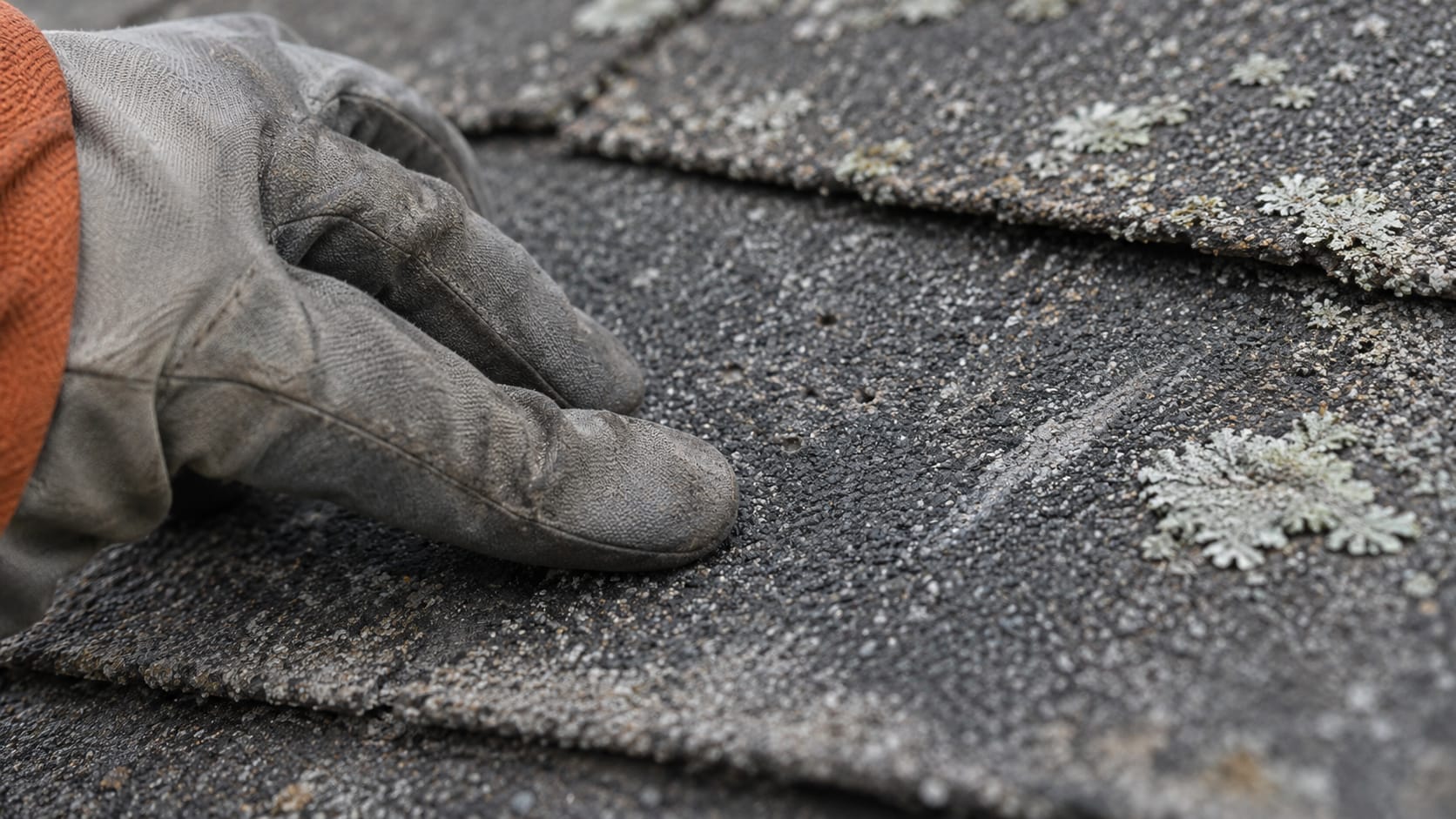
The look-alikes, one by one
| Condition | Cause | Tell-tale |
|---|---|---|
| Blisters | Poor-quality asphalt combined with heat1 | Small raised bubbles; when ruptured, steep-sided voids usually 1/4 inch across or less, often down to the mat1 |
| Edge granule loss | Natural weathering5 | Follows the edges of shingles; uniform wear or discoloration across the roof5 |
| Crazing and flaking | Asphalt shrinkage with age1 | Fine surface cracking, then chunks of granules flaking away from the mat1 |
| Cupping and clawing | Asphalt shrinkage on the top or bottom surface1 | Corners and edges of the shingles curl1 |
| Splitting | Asphalt shrinkage, deck movement and low tensile strength in the mat1 | Diagonal or horizontal lines, not round marks1 |
| Marring from foot traffic | Walking on shingles that are hot, soft and pliable1 | Asphalt and granules pushed aside with a ridge on the outer edge of the mark; scuffed bottom edges1 |
| Elevated fasteners | Nails or staples not driven flush, or driven into joints in the decking1 | A raised or buckled spot with a fastener beneath it1 |
| Adhesive spots | Sealant dripped onto a shingle, or two shingles bonded and pulled apart1 | A round dark spot, or a rounded patch of missing granules1 |
| Manufacturing defects | Insufficient granule or asphalt coverage at the plant1 | Bands or spots of missing material; deterioration consistent across most slopes17 |
| Intentional mechanical damage | Hammers, coins or screwdrivers used to simulate hail1 | Groups or lines of marks, centred on shingles, one per shingle, on every slope1 |
Blistering
Blisters are a frequent source of confusion, because a ruptured blister is round and bare like a small hail hit. Haag describes them as small bubbles where part of the granule surface is raised. The bubbles eventually rupture and expose steep-sided voids that frequently reach the shingle mat. They are usually a quarter inch in diameter or less and are not caused by hailstone impact1. IIBEC's journal lists blisters among common manufacturing issues, with localized granule loss, splitting and delamination7. Size and profile do much of the sorting. A quarter-inch pit with steep sides is a different object from the bruise left by a stone of an inch or more.
Granule loss
Granule loss is the point on which the published sources disagree. Haag's own paper calls it a controversy1.
Haag's position rests on a ten-year experiment. Granules were brushed off new shingles in measured amounts and the shingles were left to weather in Dallas. Between 12% and 15% of the surface granules had to be removed before the mat was exposed at all, and after ten years only the shingle stripped of every granule showed real erosion1. The firm concludes that granules lost in a hailstorm do not shorten a roof's life where the impact areas are not bruised or punctured and remain covered1. It does count granule loss as hail damage where hail scuffs away enough to expose substantial bitumen2.
Manufacturers and IBHS put more weight on the long term. Atlas Roofing says an impact can loosen the bond so that granules fall away over the following months4. IBHS found that small hail knocks away protective granules and speeds up ageing8. CertainTeed advises a professional inspection when a large accumulation of granules appears after hail9. The Canadian manufacturers' association, as Haag summarises its bulletin, treats small areas of missing granules as an aesthetic condition and reserves "functional" for loss that is easily visible from the ground or for fractures through the back of the shingle2.
The common ground is narrow. Haag, the Canadian bulletin and the roofing contractors' journal all decline to treat granule loss alone, with no bruise and no exposed asphalt, as functional hail damage26.
Foot traffic and installation marks
Roofs are walked on during installation, inspection and maintenance2. On a hot day the asphalt softens enough to be pushed aside with the granules, forming a ridge at the outer edge of the mark, and shoes scuff granules from the bottom edges of shingles1. IBHS shows a scuff mark from installation among its examples of what is not hail damage5.
On other materials foot traffic has its own marks. A split in a wood shake made by a footfall is identical to a hail split except that it has no sizeable dent beside it, and a near-linear crack across a slate is usually the work of a foot6.
Damage made to look like hail
Haag's engineers report having inspected numerous roofs where someone used tools to simulate hail in order to defraud an insurer, and they describe what gives it away1. The marks are not random. They sit in groups or lines in the upper part of a slope, away from the edges, and in the centre of each shingle, because people aim for the middle. They tend to occur once per shingle and at a perpendicular angle on every affected slope, which would require hail to have come from several directions at once. Under magnification, a metal tool leaves shattered granule coating as a powder residue, and a claw hammer leaves a curved fracture that opens toward the direction of the blow1.
Old hail and new hail
A mark can be genuine hail and still belong to the wrong storm. Three clocks run at different speeds. Exposed asphalt is black when fresh and oxidises to grey over several months1. Spatter marks typically linger for about a year, depending on exposure and climate6. Dents in metal are permanent and accumulate with every storm6. Haag's protocol uses these to decide whether damaging hail fell recently, fell long ago, or left no evidence at all2.
None of the three gives a date. That comes from weather records, which the guide to proving when hail fell covers.
Six questions that settle most roofs
- Was the hail capable? Compare the size shown by the property's metal with the threshold for the roofing.
- Is the pattern random and weighted to one side? Uniform marks on every slope point away from hail.
- Is there a bruise or an underside fracture? A bare spot with a firm, unbroken mat beneath it is not functional hail damage.
- Do the weakest shingles show it? Ridges and valleys bruise first. If they are clean, the field of the roof should be too2.
- How old is the mark? Black asphalt and visible spatter indicate a recent storm; grey asphalt and no spatter an old one.
- Who decides if the parties disagree? Insurers typically bring in a third party, such as a roof consultant, engineer or architect, to give an opinion on the cause7. A policyholder or contractor can commission the same kind of inspection.
A roof assessed this way produces a report in which each mark is assigned a cause and a reason, and the reader can follow the reasoning without being on the roof.
How do you tell hail damage from blistering?
Blisters are small bubbles in the shingle surface that rupture into steep-sided pits, usually a quarter inch across or less, and they come from poor-quality asphalt and heat. A hail impact sits over a soft bruise where the mat is fractured, appears at random among other impacts and is matched by dents and spatter marks on metal around the property.
Do granules in the gutter mean hail damage?
Not on their own. Shingles lose granules from the day they are made, and heavy rain washes them off. A large accumulation right after a hailstorm is a reason to have the roof inspected, and the inspection looks for bruises and fractures, not for missing granules alone.
How can you tell old hail damage from new?
By colour and by spatter. Asphalt exposed by a recent impact is black and oxidises to grey after several months. Spatter marks, where hail has cleaned grime and oxide off a surface, typically linger for about a year. Dents in metal last indefinitely and record every storm the roof has been through.
How do adjusters spot fake hail damage?
Haag Engineering's research lists the signs. Marks made with a hammer or coin sit in groups or lines, in the centre of shingles and high on the slope, usually one per shingle, and they appear on every slope at the same perpendicular angle. Metal tools also crush the granules and leave a powder residue in the mark.
What is a hail bruise on a shingle?
An indentation with a fracture in the shingle's reinforcing mat. It feels soft under the fingertips, like the bruise on an apple, and it is usually easy to find because the impact has knocked the granules away around it. The fracture can be seen on the underside of the shingle.
Sources
- Hail Damage to Asphalt Roof Shingles (Marshall, Herzog and Morrison; American Meteorological Society Annual Meeting, 2004). Haag Engineering Co.. Accessed 20 Nov 2026.
- Assessing Hail Damage: Part 2, Hail Inspection Protocol (Kestner, Smith and Chaney; October 2019). Haag. Accessed 20 Nov 2026.
- Identifying Hail Damage to Your Roof. Travelers. Accessed 20 Nov 2026.
- Technical Bulletin: Detecting Hail Damage on Asphalt Shingles. Atlas Roofing Corporation. Accessed 20 Nov 2026.
- Is It Hail Damage?. Insurance Institute for Business & Home Safety (IBHS). Accessed 20 Nov 2026.
- Holy hail! (Scott J. Morrison, P.E., Haag Engineering Co.). Professional Roofing, National Roofing Contractors Association, 1 May 2009. Accessed 20 Nov 2026.
- Asphalt Composition Shingle Damage: Hail or Manufacturing Defect? (Darrell L. Smith, RRC, PE; Interface, February 2013). IIBEC. Accessed 20 Nov 2026.
- Impact Testing of High Concentrations of Small Hail. Insurance Institute for Business & Home Safety (IBHS). Accessed 20 Nov 2026.
- Hailstorms. CertainTeed. Accessed 20 Nov 2026.
Updated 20 Nov 2026: First published.